

Photo: Max Au
K
Chi-pan Wong, Ph.D.
ennedy
Assistant Professor of Sociology
The King's University, Canada

This was My Home.
Photo: Max Au

As a political sociologist, I study
HOW
MULTIPLE
FORMS OF
POLARIZATION SHAPE
WHO "WE" ARE
IN
POLITICS.
A POLITICAL SOCIOLOGY
OF POLARIZATIONS


ABOUT KENNEDY
Living in a world marked by multiple crises, we constantly navigate different political contexts—from genocide in one place and political imprisonment in another to hostility toward newcomers where we live. Following every crisis can be exhausting. People often manage their political life by establishing priorities and boundaries. One may find some issues urgent, others irrelevant, and still others difficult or problematic to support publicly.
I study how migrant activists today connect multiple political worlds in their efforts to fight for “democracy.” In doing so, however, they inevitably become selective about what they consider urgent and important. I seek to understand how they connect these different political concerns and how these multiple commitments can turn their relationships with allies into paradox-laden processes.


I study migrant-involved activism
and develop theories to help us
better understand their life and struggles.
Hong Kong Diasporas
Transnational Repression
Minority Activism
Migration
Oral Histories

Understanding the
Civic Side of
Transnational Repression
Published in American Behavioral Scientist, 2024.
In this research article, I propose a framework for understanding how members of nationalist diasporas may voluntarily support their homeland regimes in carrying out transnational repression.
The paper grew out of my own field observations and personal experiences of surveillance, harassment, and assault by pro-PRC loyalists. These experiences pushed me to rethink the common assumption that diaspora politics is always democratic and cosmopolitan. Authoritarian regimes can also rely on emigrants to extend political control beyond national borders, mobilizing loyalists to monitor, intimidate, and suppress dissent abroad.
While the empirical data only represents the case of Hong Kongers, I found the framework also speaks to the experiences of mainland Chinese, Uyghur, Tibetan, Iranians, Syrians, Palestinians, and other diaspora activists who have faced similar forms of repression from members of their own or adjacent nationalist communities. I hope this work can contribute to a broader line of inquiry into how authoritarian regimes influence emigrant civic organizations and mobilize diaspora actors for political control.

Hong Kong Migrants and Their Future Anticipations
Published in Journal of International Migration and Integration, 2022.
Why do migrants return to Canada after previously finding it difficult to settle there?
In 2018, I worked with Professor Miu Chung Yan at the University of British Columbia on a migration project. I conducted 20 interviews with families who had moved back and forth between Canada and Hong Kong. We found that these families had not originally planned such circular migration trajectories. Instead, their movements were shaped by historical contingencies, including economic downturns, political turmoil in their homeland, and changes in their personal life courses.
They were constantly recalibrating their visions of the future as they made decisions about moving across borders. From one perspective, they could be seen as privileged because they had the flexibility to move between places. From another, however, they faced considerable risk, lack of support, and precarity as they moved back and forth.
What made them change their minds about where to live? Their decisions emerged from an ongoing negotiation among changing social, political, and personal circumstances, as multiple anticipations of societal change and future risks interacted with one another.

MULTIPOLARITY
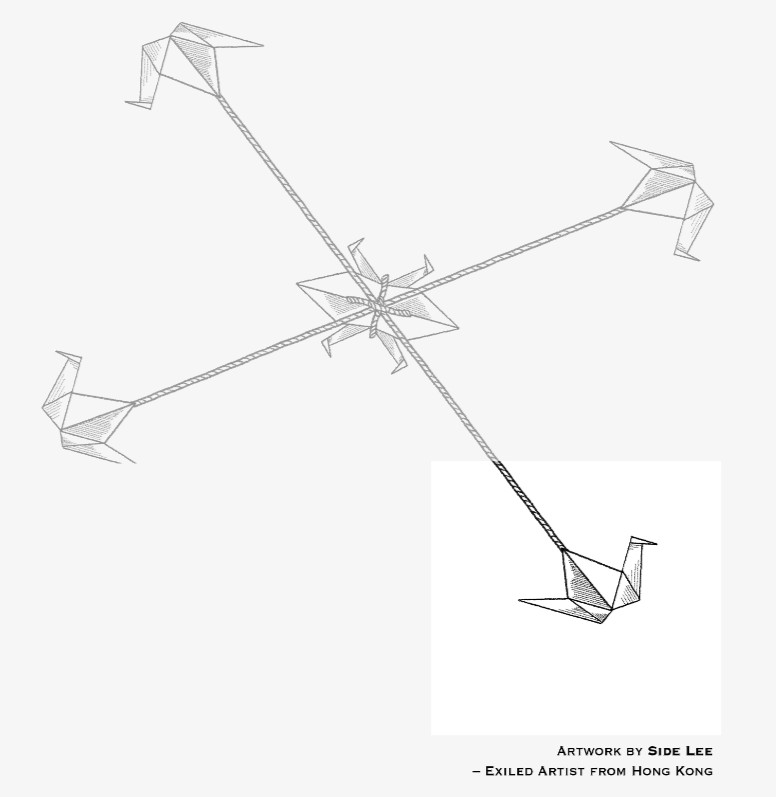

In the spring of 2025, while I was still writing my Ph.D. dissertation, I began sharing research memos with Side Lee, an exiled Hong Konger artist. In response, Side created a series of artworks based on my writing.
-
Compass: symbolizing direction and guidance, with its points extending to all four corners to echo the theme.
-
Rope and Knots: the rope represents connection, while the knots symbolize entanglement—illustrating the coexistence of opposing poles in a polarized relationship.
-
Art Deco Symmetry: the use of symmetry in the Art Deco style reflects duality—mirror images that are aligned yet opposite.